Vaping in Europe in 2026: where the rules stand, country by country
Published on June 19, 2026 · Updated on September 10, 2026
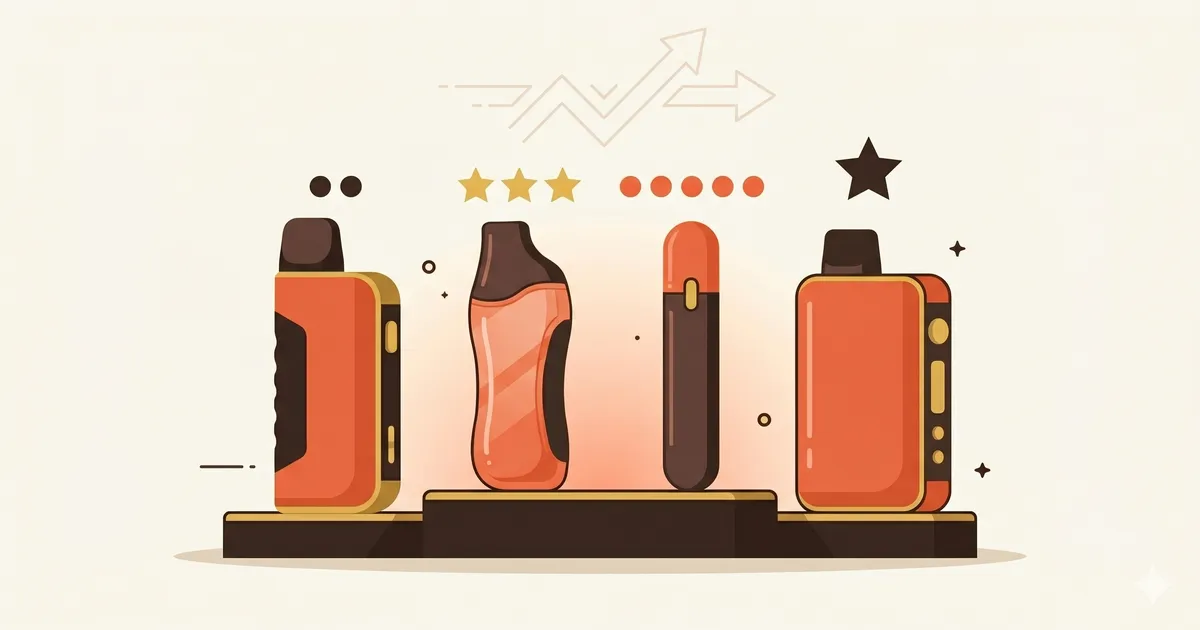
In September 2026, the electronic cigarette is no longer a regulatory grey area in Europe. Four countries already ban disposables, Ireland has voted its own for January 2027, France is outlawing nicotine pouches and Ireland now taxes e-liquid by the millilitre.
This article recommends no device: it sets out the law that applies. No nicotine product is risk free, and the public health objective remains stopping nicotine use altogether.
The wave of disposable bans
Belgium led the way: since 1 January 2025, selling fully disposable electronic cigarettes has been prohibited there, a first in the Union.
France followed with Law no. 2025-175 of 24 February 2025, in force since 26 February. Its Article L. 3513-5-1 covers pre-filled devices that cannot be refilled, whether or not the battery is rechargeable, and expressly excludes cartridges.
- Belgium: sale prohibited since 1 January 2025.
- France: ban in force since 26 February 2025.
- United Kingdom: since 1 June 2025, any device that cannot be recharged or refilled is banned, nicotine free versions included.
- Bulgaria: a ban is also in place, according to the European Commission's April 2026 evaluation.
- Ireland: act signed on 15 July 2026 and commenced on 24 July, but its section 7 defers the sales ban by six months, to 24 January 2027.
These texts ban a format, not nicotine. Pre-filled cartridges remain legal in France and Belgium, and the market has shifted towards rechargeable devices.
What EU law already imposes everywhere
Directive 2014/40/EU, applicable since 20 May 2016, frames the whole market: a maximum of 20 mg/ml of nicotine, 2 ml per tank, 10 ml per refill container. Products are notified before they reach the market and cross border advertising is prohibited.
Delegated Directive (EU) 2022/2100 added, on 23 October 2023, a ban on characterising flavours in heated tobacco. The Council Recommendation of 3 December 2024 invites states to extend smoke free areas to aerosols: it is not binding, but Spain has acted on it.
Nicotine pouches: banned here, capped there
Decree no. 2025-898 of 5 September 2025, published in the French Official Journal on 6 September, bans oral nicotine products in France from 1 April 2026, apart from cessation medicines and chewing tobacco.
Two rulings have since changed its scope. On 22 December 2025, the interim relief judge of the Conseil d'État suspended the decree in so far as it bans manufacture, production and export (no. 509561). On 13 July 2026, ruling on the merits, the Conseil d'État upheld the bans on supply, transfer, acquisition and use, but referred to the Court of Justice of the European Union the questions on production, transport, import, export and possession, under Articles 34, 35, 49 and 56 TFEU (no. 509446). Sales therefore remain banned, the industrial side is unsettled.
Elsewhere, regimes diverge. Belgium has banned these products since 1 July 2023 and the Netherlands since 1 January 2025. Others cap the content: Poland at 20 mg per gram since 5 July 2025, Italy at 16.6 mg per pouch since 1 January 2026. Details in our dedicated guide.
Taxation, the next front
Since 1 November 2025, Ireland has applied an excise duty of 500 euros per litre of e-liquid, that is 50 cent per millilitre, or 5 euros for 10 ml. The European proposal of 16 July 2025 would extend that logic to all twenty seven member states, subject to unanimity: see the EU tax revision.
The main product families
- Pod with pre-filled cartridges: rechargeable battery, disposable refill. This format absorbed part of the disposable market.
- Refillable rechargeable pod: a tank capped at 2 ml, a bottle capped at 10 ml.
- Adjustable tank kit: power and airflow can be set.
- Heated tobacco: legally a tobacco product, with no characterising flavour since 2023.
WHO holds that consumer electronic cigarettes have not been proven effective for quitting at population level, and that dual use is at least as dangerous as smoking alone. The Commission's evaluation points the same way: only 21 % of respondents to the 2023 Eurobarometer reported quitting tobacco entirely after switching to e-cigarettes. Our guide to quitting reviews the methods. In France, Tabac Info Service answers on 39 89.
What 2026 is preparing
On 2 April 2026, the European Commission published its evaluation of the EU tobacco framework: smoking has fallen from 28 % to 24 % in the Union since 2012. The document notes that about one in five consumers of tobacco and nicotine products aged 15 to 19 started by regularly using e-cigarettes. An overhaul is announced for 2026, following the tobacco free generation plans. WHO Europe noted on 8 October 2025 that 14.3 % of 13 to 15 year olds vape, against 4.6 % of adults.
Sources
- Disposables, France: Public Health Code, Art. L. 3513-5-1
- Disposables, Belgium: consolidated royal decree
- Disposables, United Kingdom: GOV.UK
- Disposables, Ireland: Single-Use Vapes Act 2026, Oireachtas file, commencement
- Oral nicotine, France: Decree no. 2025-898
- French litigation: Conseil d'État, 22 December 2025, no. 509561 and 13 July 2026, no. 509446
- Pouches, Belgium and Netherlands: royal decree of 14 March 2023, Stb. 2024, 292
- Pouches, Poland and Italy: Dz.U. 2025 poz. 799, Law no. 199/2025
- EU rules: European Commission, Delegated Directive (EU) 2022/2100
- Aerosol free areas: Council Recommendation
- 2026 evaluation: SWD(2026) 111, press release
- Taxation: European proposal, Irish rate
- Health: WHO, WHO Europe
Related reading
Rolling Tobacco vs Packaged Cigarettes: The Price Gap Explained
Rolling your own cigarettes has long cost less than buying a pack. But where does that gap come from, and will it last? We break down the tax and the real cost per cigarette.
Nicotine replacement therapy (patch, gum, spray): how it works and how effective it is
Patches, gum, lozenges, sprays or inhalers: a factual overview of nicotine replacement therapy, how it works and its proven effectiveness for quitting smoking.
Getting Support to Quit Smoking: Counselling, CBT, Helplines and Apps
Brief advice from your doctor, specialist counselling, CBT, free helplines and apps: why support markedly raises your chances of quitting, especially combined with treatment.