Travelling with nicotine pouches: what customs actually says, country by country
Published on September 22, 2026
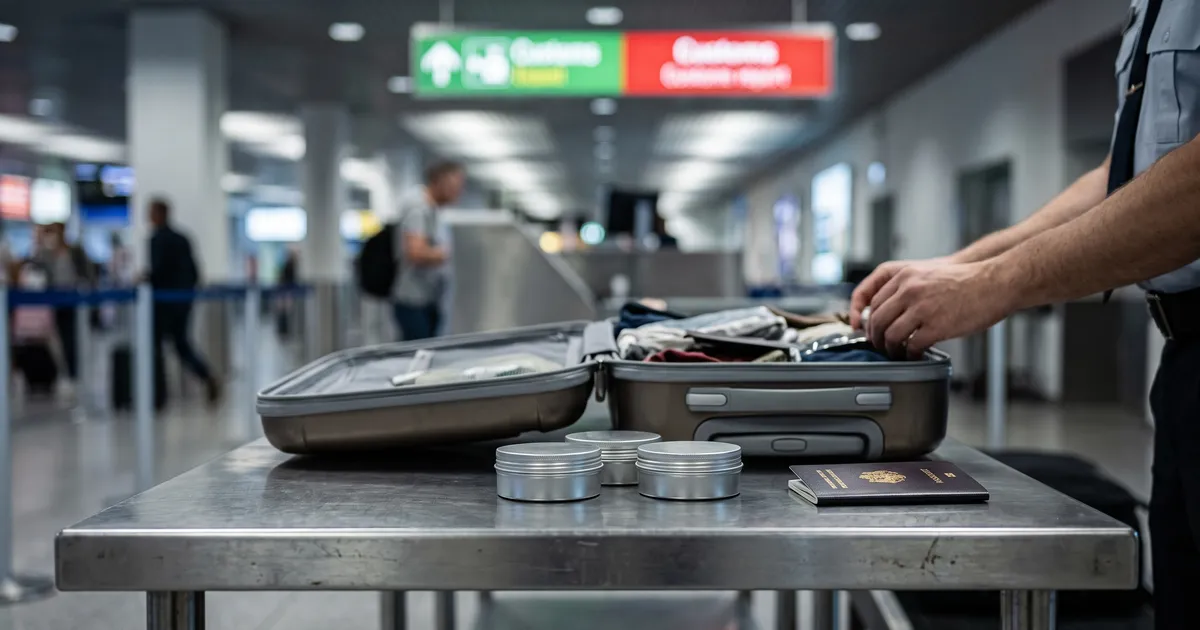
The European Union's official page on what a traveller may carry gives precise amounts: 800 cigarettes, 400 cigarillos, 200 cigars, 1 kg of tobacco between member states. Look for nicotine pouches and you will not find them.
That is not a drafting oversight, and it is the whole difficulty. In September 2026 these products fall outside the European framework, so no allowance protects you. Here is what actually applies when you cross a border with them.
Why there is no European allowance
Directive 2014/40/EU governs tobacco products across the Union. The Commission lists what it covers: cigarettes, roll-your-own tobacco, pipe tobacco, cigars, cigarillos, smokeless tobacco, electronic cigarettes and herbal products for smoking. Nicotine pouches are not on that list, because they contain no tobacco.
With no harmonisation, each state legislates alone, and the rules diverge sharply from one border to the next. The practical consequence is simple: the law of the country you enter decides, not the law of the country where you bought them.
For cigarettes, exceeding the indicative amount raises a presumption of commercial use. For nicotine pouches, in a country that bans them, there is no threshold to exceed: the permitted quantity is zero.
The French case, settled in July 2026
A decree of 5 September 2025 banned oral nicotine products from 1 April 2026. The Conseil d'État suspended part of it on 22 December 2025, which created a confusing situation.
On 13 July 2026 it ruled on the merits. It held the ban on offering, transferring, acquiring and using these products lawful, finding the measure justified by the protection of public health and proportionate. It did however refer one precise question to the Court of Justice of the European Union: whether production, transport, import, export and possession may also be banned when those operations are aimed exclusively at sale in another member state.
That referred question concerns trade, not travellers. For a private individual the rule is clear in September 2026: acquiring and using nicotine pouches is prohibited in [France](/pays/france), including pouches bought legally elsewhere.
Where you can take them, and where you cannot
The legal position as we write, in September 2026. It moves fast, so check before you travel.
- Banned: France, Belgium, the Netherlands. Do not carry them, whatever the quantity.
- Heavily restricted: Germany, where they are banned above 20 mg of nicotine per pouch, which rules out most major brands. Denmark, permitted since April 2026 but capped at 9 mg and limited to tobacco and menthol flavours.
- Legal: Sweden, where they fall under the same framework as snus, the United Kingdom, Spain, Italy and Portugal, the last two being taxed.
- Outside the Union: always check. Several countries in Asia and the Gulf ban nicotine products outright.
The country-by-country detail, with thresholds and entry-into-force dates, is in our guide to the legality of nicotine pouches in Europe.
Three situations travellers underestimate
By air. Pouches are not liquids, so the 100 ml rule does not apply to them, and they travel in the cabin or the hold alike. But the bag is not the issue: what counts is the law of the country of arrival, and a connection in a country that bans them is enough to cause trouble.
By car. Bringing pouches from Spain or Italy into France is not a matter of an allowance you must not exceed, but of a prohibition. The quantity logic familiar from cigarettes does not apply here.
Ordering online. Buying from a foreign site amounts to importing. An intercepted parcel is seized, and acquisition is itself banned in the countries concerned.
What you risk
Seizure of the product is the most common outcome, together with a fine. This is not a matter of unpaid customs duty, as it would be for excess cartons, but a breach of health regulation. We set out the regime that applies to cigarettes, which follows an entirely different logic, in our guide to buying tobacco abroad.
One last point. Nicotine pouches are not validated quit-smoking aids: they replace one source of nicotine with another without treating the dependence. If your aim is to quit, our dedicated section reviews the methods whose effectiveness is documented.
Sources
- Indicative amounts for travellers, 800 cigarettes and 1 kg of tobacco: Your Europe, European Commission
- Scope of Directive 2014/40/EU: European Commission, tobacco product regulation
- Ruling on the merits and referral to the Court of Justice, 13 July 2026: Conseil d'État, no. 509446
- Partial suspension of the decree, 22 December 2025: Conseil d'État, no. 509561
- Tobacco taxation in the Union and the products covered: European Commission
Related reading
Rolling Tobacco vs Packaged Cigarettes: The Price Gap Explained
Rolling your own cigarettes has long cost less than buying a pack. But where does that gap come from, and will it last? We break down the tax and the real cost per cigarette.
Nicotine replacement therapy (patch, gum, spray): how it works and how effective it is
Patches, gum, lozenges, sprays or inhalers: a factual overview of nicotine replacement therapy, how it works and its proven effectiveness for quitting smoking.
Getting Support to Quit Smoking: Counselling, CBT, Helplines and Apps
Brief advice from your doctor, specialist counselling, CBT, free helplines and apps: why support markedly raises your chances of quitting, especially combined with treatment.