Buying Cigarettes Abroad: What Customs Says (2026 Guide)
By Bryan Schmitt · Published on June 28, 2026
With a pack of Marlboro costing over €13 in France in 2026 (versus around €3.20 in 2000), and nearly €17 in the United Kingdom, the idea of stocking up while travelling is bound to cross your mind. In some neighbouring or nearby countries, such as [Tunisia](/pays/tunisie) or [Andorra](/pays/andorre), a comparable pack sells for around €3. The gap is real. But bringing tobacco back from abroad follows precise customs rules that are worth knowing before you leave. This neutral guide reviews the legal framework in 2026.
Why it's tempting: the price gaps between countries
The reason is simple: taxes make up 70 to 80% of a pack's price, and each country sets its own excise levels freely. The result is striking differences from one border to the next. A regular smoker may see a trip abroad as a chance to save a significant amount.
That temptation is understandable, but it changes nothing about the rules. What you may bring back depends not on the price you paid, but on the quantity carried and the use you make of it. That is precisely what customs check.
The principle within the European Union: free movement for strictly personal use
Within the European Union, the market is a single one: goods, including tobacco, move freely. In practice, if you buy your cigarettes in another EU country, you pay that country's taxes and, in principle, you have nothing to declare on your return.
One essential condition applies, however: the purchase must be for your strictly personal use. The tobacco must be carried by you, for your own consumption. As soon as it is intended for resale, shared in exchange for payment, or transported on behalf of someone else, you fall outside this framework and the purchase may be reclassified as a commercial purchase.
Indicative limits in the EU: around 800 cigarettes
To help tell personal use apart from a commercial purchase, the authorities use indicative thresholds. The one most often cited in the EU is around 800 cigarettes, the equivalent of 4 cartons per person. It is important to understand the nature of these figures:
- These are indicative thresholds, not automatic allowances: they serve as a benchmark for customs, not as a guaranteed right.
- They vary between countries: each member state may set its own reference levels, sometimes lower.
- Above these thresholds, you may be suspected of a commercial purchase and asked to prove that the tobacco is genuinely for your own consumption.
- Other clues matter too: the frequency of your trips, how the tobacco is packaged and presented, and your explanations.
In other words, staying below the threshold does not guarantee you won't be checked, and slightly exceeding it is not automatically an offence: it is the overall context that is assessed.
Outside the EU and at external borders: much lower allowances
The situation changes entirely when you cross an external border of the Union, for example returning from Tunisia, or even from Andorra, which is not an EU member and has its own rules. We are no longer talking about indicative thresholds, but about allowances: maximum quantities you may import free of tax.
These allowances are markedly lower. For tobacco, the limit often applied is around 200 cigarettes, or 1 carton per adult traveller. Beyond that, the tobacco must in principle be declared and give rise to payment of the duties and taxes due on entering the territory.
It is therefore essential not to confuse the two regimes: what is tolerated between two EU countries has nothing to do with what is allowed from a non-EU country. Andorra, in particular, often surprises travellers, because its low prices come with specific and limited allowances.
What tips it into illegality
As long as the tobacco stays with you, in reasonable quantities, and the taxes of the country of purchase have been paid, you are within a legal framework. Several elements, however, change the picture:
- Resale: reselling, even to people you know and even without an obvious profit, is a commercial activity prohibited in this context.
- Exceeding thresholds or allowances without declaring or paying the duties due.
- Carrying for others: bringing back tobacco for friends or colleagues takes you outside personal use.
- Concealment: hiding the goods or refusing to declare them worsens the situation in the eyes of customs.
The common thread is always the same: the line between legal and illegal does not depend on the price paid, but on the actual purpose of the tobacco and on compliance with the formalities.
Possible penalties and good habits
In the event of a breach, the consequences can range from simple regularisation (payment of the duties and taxes due) to seizure of the goods, and even to fines proportionate to the quantity and the intent. Penalties vary by country and by the seriousness of the facts, which is why prevention is better than cure.
A few simple habits make for stress-free travel:
- Check before you leave with the customs authority of the country of return, as rules change.
- Keep your receipts: till receipts and invoices proving the purchase and the quantity.
- Stay within reasonable quantities, consistent with personal consumption.
- Declare voluntarily what needs to be declared rather than risking a check.
- Never carry tobacco on behalf of someone else.
Well informed, a traveller avoids most unpleasant surprises. This guide is purely informative and does not constitute legal advice: when in doubt, the customs administration remains the reference source. The full price comparison by country is here.
Related reading
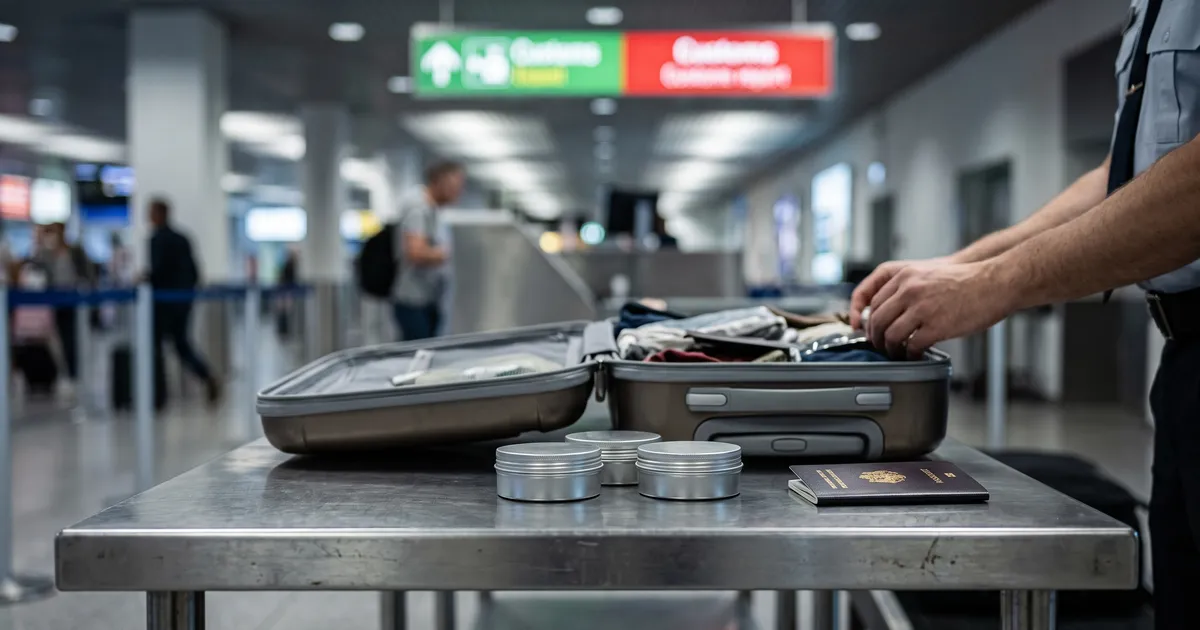
Travelling with nicotine pouches: what customs actually says, country by country
There is no European allowance for nicotine pouches. The law of the country you enter is what applies, and where they are banned the permitted quantity is zero.
Rolling Tobacco vs Packaged Cigarettes: The Price Gap Explained
Rolling your own cigarettes has long cost less than buying a pack. But where does that gap come from, and will it last? We break down the tax and the real cost per cigarette.
Nicotine replacement therapy (patch, gum, spray): how it works and how effective it is
Patches, gum, lozenges, sprays or inhalers: a factual overview of nicotine replacement therapy, how it works and its proven effectiveness for quitting smoking.