Does raising tobacco prices really cut smoking rates?
By Bryan Schmitt · Published on June 28, 2026
In France, a pack of Marlboro cost around €3.20 in 2000. By 2026 it exceeds €13. This surge is no accident: it is a deliberate policy built on a simple idea, make tobacco more expensive so people consume less of it. But does the strategy really work? And at what social cost? Here is a nuanced answer.
The theory: price elasticity of demand
Economists measure how sensitive a product is to its price through the price elasticity of demand: by how much does consumption fall when the price rises? For tobacco, this elasticity is considered moderate but very real. The rule generally accepted in high-income countries: a 10% price increase leads to roughly a 4% drop in consumption.
Tobacco is addictive, so it is less price-sensitive than other goods. But dependence does not remove the response to price: it only dampens it. Beyond a certain threshold, the tobacco budget becomes hard to sustain, and price acts as a powerful signal.
What the data shows
Studies converge: higher prices reduce consumption. And they do not do so uniformly. The effect is strongest in two key groups:
- Young people, who have limited spending power and are not yet heavily dependent: a high price discourages taking up smoking in the first place.
- Lower-income households, for whom tobacco weighs heavily on the budget: they cut down or quit more than wealthier households.
- Heavy smokers, who reduce the number of daily cigarettes even when they do not quit entirely.
Price therefore acts on initiation (fewer new smokers), on intensity (fewer cigarettes per day) and on cessation (more quit attempts).
High-price countries versus low-price countries
International comparison illustrates the link. The United Kingdom, where a pack reaches the equivalent of about €17, shows a steadily falling smoking prevalence. France, after years of planned increases up to €13 and beyond, has seen its share of daily smokers drop markedly over the past decade.
Conversely, in several countries where a pack still hovers around €3, consumption remains high and falls more slowly. Price does not explain everything (culture, regulation and prevention matter too) but the correlation is robust enough to be taken seriously.
The limits of the strategy
Raising the price is no magic bullet. Three limits come up again and again:
- The parallel market: cross-border purchases, smuggling and counterfeiting grow when price gaps between countries are large, which erodes the expected effect on both consumption and revenue.
- Switching to cheaper products: some smokers do not quit but move to roll-your-own tobacco, often taxed less, or to budget brands.
- Social equity: the tax falls proportionally harder on lower-income households, who smoke more. As long as they do not quit, the levy is regressive, hence the importance of pairing it with cessation support.
The WHO's stance
The World Health Organization is unambiguous: taxation is, in its view, the single most effective and cost-effective public health lever to reduce smoking. It recommends that taxes make up a majority share of the retail price, a threshold already passed in Europe, where they reach 70 to 80% of a pack's price.
Raising taxes on tobacco is the most effective measure to reduce consumption and save lives, while generating revenue to fund health. Stance of the World Health Organization
Beyond price: complementary measures
Price is the most powerful lever, but it works best combined with other measures. Prevention and education aim to stop people taking up smoking. Cessation support (nicotine replacement, counselling, quit lines) helps those who want to stop and partly corrects the tax's regressive effect. Plain packaging, advertising bans and smoke-free spaces round out the toolkit.
A frequently cited example is Sweden, which has one of the lowest smoking rates in Europe (under 5%) thanks to a combination of measures. The upcoming revision of the EU tobacco directive, expected around 2028-2030 (often nicknamed "TPD3"), could strengthen this comprehensive approach across the continent.
Related reading
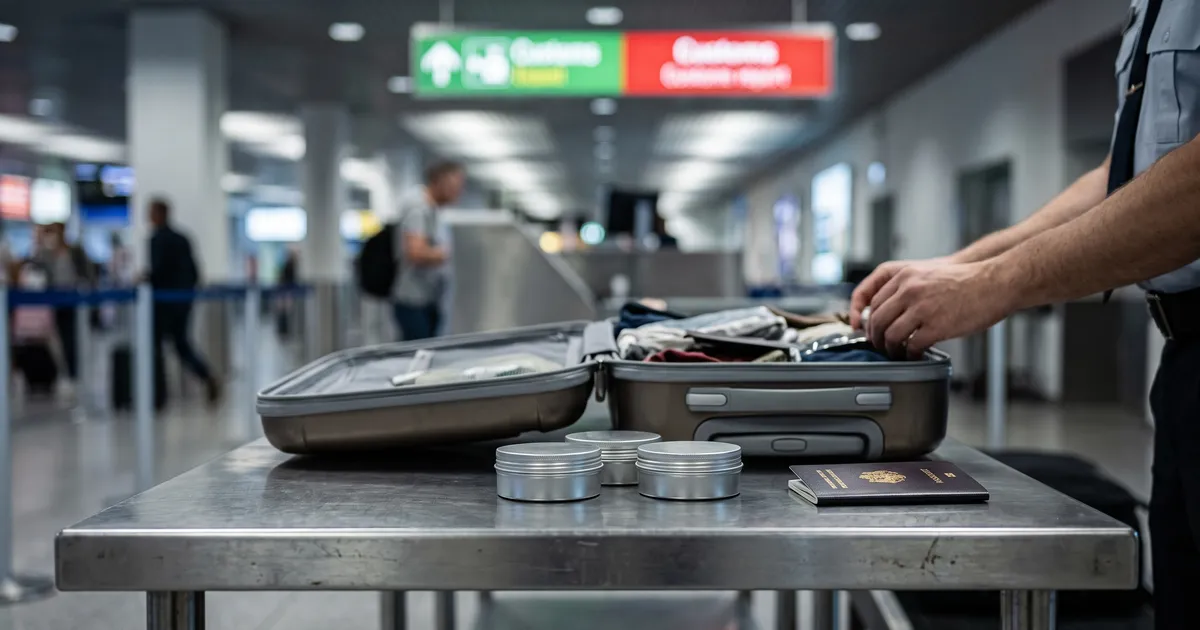
Travelling with nicotine pouches: what customs actually says, country by country
There is no European allowance for nicotine pouches. The law of the country you enter is what applies, and where they are banned the permitted quantity is zero.
Rolling Tobacco vs Packaged Cigarettes: The Price Gap Explained
Rolling your own cigarettes has long cost less than buying a pack. But where does that gap come from, and will it last? We break down the tax and the real cost per cigarette.
Nicotine replacement therapy (patch, gum, spray): how it works and how effective it is
Patches, gum, lozenges, sprays or inhalers: a factual overview of nicotine replacement therapy, how it works and its proven effectiveness for quitting smoking.