Tobacco prices in France in 2026: six increases in eight months, and more to come
By Bryan Schmitt · Published on August 1, 2026
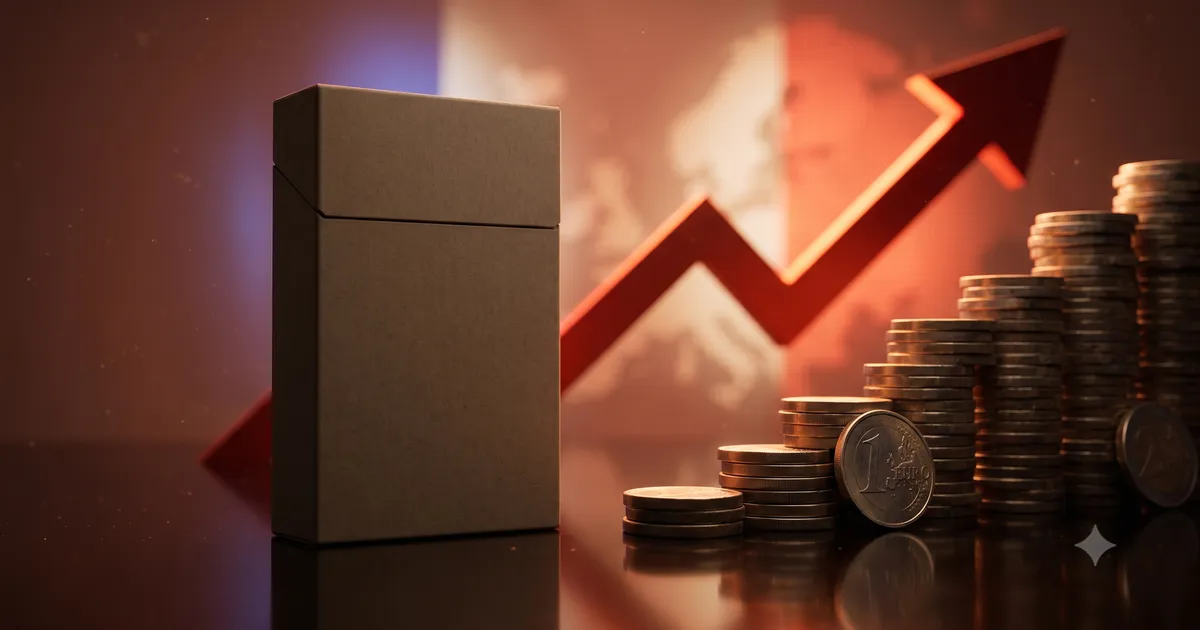
Six tobacco price increases in eight months: it has never happened before in France. Throughout 2026, price hikes are following one another at an unprecedented pace, January, February, March, June, September, November. At each official order, tobacconists update their price tags and smokers watch their budgets grow a little heavier. A pack of Marlboro Red now exceeds €13.50, and several major brands have crossed the symbolic €13 threshold.
This relentless rhythm is not accidental. It is part of a deliberate plan: the National Programme to Combat Tobacco 2023-2027, which set a target of reaching €13 per pack in 2026. Mission accomplished, and surpassed for some brands. But what does this price really represent? And why is France one of the most expensive countries in Europe for smokers?
Over 80% of the price goes straight to taxes
In France, taxation accounts for more than 80% of the price of a pack. This breaks down into three elements: a fixed specific tax (per-cigarette unit duty), an ad valorem tax proportional to the retail price, and 20% VAT. Manufacturers receive only a small fraction of the shelf price. The bulk goes to the state.
Since 2024, the specific portion of the tax has been indexed to the government's inflation forecast for the previous year, excluding tobacco. This mechanism ensures prices rise at least every year, even without an explicit political decision. Official price orders published during the year then translate these indexations into concrete per-brand increases, with some variation depending on manufacturers' strategies.
The 2026 calendar: six hikes in eight months
- 1 January 2026: +€0.10 to +€0.50 per pack depending on brand, several major brands cross €13
- 1 February 2026: new wave, Marlboro Red reaches €13.50, Philip Morris reaches €13
- 1 March 2026: third order, additional +€0.10 to +€0.80 depending on product
- June 2026: fourth hike of the year, extra pressure on roll-your-own tobacco
- September 2026: fifth revision, new increases planned
- November 2026: sixth and final order of the year to consolidate the price floor
France vs Europe: staggering price gaps
France is one of the most expensive countries in Europe for tobacco. A pack of twenty cigarettes costs an average of €12.76 there, compared to €8.18 in Germany, €6.51 in Italy and just €5.39 in Spain. The European average sits at around €6.87. In other words, smoking in France costs almost double the European average.
These gaps naturally attract cross-border buyers. Customs rules allow you to bring back into France 800 cigarettes (4 cartons) from an EU country such as Spain, but only 300 cigarettes from Andorra, which lies outside the EU customs area. Exceeding these limits carries a minimum fine of €750, rising to €7,500 if customs suspects commercial intent. The savings are simply not worth the risk.
Why such large gaps between countries?
Tobacco tax policy is a matter of national sovereignty within the EU, the European directive sets a minimum floor, not a uniform level. France chose a high-tax approach from the early 2000s onwards, as part of successive public health plans. Spain and Italy, historically closer to the European floor, are gradually closing the gap.
Italy raised excise duties by €0.15 per pack in 2026, with +€0.25 planned for 2027 and +€0.40 in 2028, a deliberate alignment trajectory. Germany raised excise by €0.11 per pack in 2026 as part of a multi-year tax reform. In both cases, the direction is clear: tobacco prices will keep rising across Europe.
"The objective is to reach €13 per pack by 2026 in order to reduce the accessibility of tobacco, particularly for young people." National Programme to Combat Tobacco 2023-2027, French Ministry of Health
What this means for your wallet
A smoker who gets through a pack a day at €13.50 spends €4,927 a year, over €400 a month. That is the budget of a phone contract, a health insurance premium, or a family holiday. This calculation is not meant to shame anyone: it is meant to put into perspective what nicotine dependence actually costs financially.
If rising prices are making you think about quitting, nicotine replacement therapy (patches, gum, lozenges) is available from pharmacies without prescription. In the UK, the NHS Stop Smoking service offers free face-to-face and online support, speak to your GP or pharmacist for a referral. Evidence consistently shows that professional support combined with NRT doubles your chances of quitting successfully. The full price comparison by country is here.
At €13.50 a pack, three months of nicotine patches cost less than six weeks of cigarettes. Medically validated, available without prescription.
Related reading
Germany plans to push a pack to €11.36 by 2030: what the bill says
The German government has tabled a bill raising tobacco tax every year from 2027 to 2030. The average pack would go from €8.77 to €11.36, moving Germany out of the European middle ground.

Tobacco taxes: why the United States taxes half as much as Europe
The American federal floor has been stuck at $1.01 a pack since April 2009, while the European Union requires €1.80 and 60% of the retail price. A figure-by-figure comparison of the two regimes.
Europe wants to shrink the tobacco price gap between countries: what would change for cross-border buyers
A pack of Marlboro costs around €5.29 in Poland and €19.20 in Ireland. Brussels wants to raise the minimum excise duty to €215 per 1,000 cigarettes and 63% of the weighted average price. The file is stalled in Parliament and still under negotiation in the Council.