Where Is Smoking Cheapest in Europe? The 2026 Ranking (and the Priciest)
By Bryan Schmitt · Published on June 28, 2026
In Europe, the price of a pack of cigarettes is anything but universal. From one border to the next, the same product can be multiplied by five. Among the nine countries tracked by cigprices.com, the [United Kingdom](/pays/royaume-uni) exceeds €17, [France](/pays/france) passes €13, while the cheapest destinations hover around €3. This factual guide lays out the 2026 ranking, from priciest to cheapest, and explains why such gaps exist.
The method: comparing a reference pack in euro equivalent
Comparing tobacco prices across Europe raises an immediate problem: not every country uses the euro. The British pound, the Polish zloty or the Tunisian dinar must be converted to allow an honest comparison. The method used here is to take a reference pack of a widely available international brand, then express its price in euro equivalent at the current exchange rate.
This approach has its limits: an exchange rate fluctuates, and a "reference" pack does not always reflect what locals actually smoke, since many fall back on cheaper local brands. But it provides a common baseline, essential for placing each country relative to the others.
The podium of the most expensive
At the top of the ranking, unsurprisingly, are the countries that have turned high prices into a deliberate public health lever. The United Kingdom dominates by a wide margin, with a reference pack approaching €17. [Ireland](/pays/irlande) follows closely, among the most expensive markets on the continent. France completes this leading trio by crossing the €13 mark.
- United Kingdom: around €17 a pack, the most expensive of the tracked countries.
- Ireland: just behind, in the same high range.
- France: over €13, after steady increases over the past twenty years.
These three countries share a common strategy: a deterrent tax policy, designed to push consumption down. Price has become as much a political tool as an economic one.
The cheapest in Europe
At the other end, the countries where tobacco remains most affordable are concentrated in clearly identified zones: Eastern Europe, the Balkans and part of the Mediterranean rim. The standard of living there is often lower, and tobacco taxation weighs less heavily. In several of these markets, a pack can cost three to five times less than in the United Kingdom.
Among the countries tracked by the site, the lowest prices sit around €3, as in Tunisia or [Andorra](/pays/andorre). These gaps do not reflect a different product, but tax choices radically opposed to those of the north-west of the continent.
The special case of Andorra
Andorra deserves a separate mention. This micro-state tucked into the Pyrenees, between France and Spain, is not part of the European Union. It therefore applies its own taxation, markedly lower than its neighbours'. The result: a pack costs around €3, four times less than in France.
This situation has made Andorra a cross-border tobacco haven, drawing buyers from France and Spain. The country perfectly illustrates how a tax border, over just a few kilometres, can create a considerable price gap.
Why such gaps exist
The key lies in one word: excise duties. These specific taxes on tobacco generally account for 70 to 80% of the final price of a pack. The cost of making the product itself is marginal; it is taxation that sets the price. And each country freely sets its own excise levels.
France's trajectory illustrates this mechanism: a pack of Marlboro cost about €3.20 in 2000, versus over €13 in 2026. This fourfold rise comes almost entirely not from the product, but from successive tax increases. Where a state chooses deterrence through price, the pack climbs; where it favours other priorities, it stays low.
What it means
Such gaps do not stay theoretical: they shape very real behaviour. We thus see purchase tourism, where travellers take advantage of a trip to stock up in a cheaper country. Border regions experience structural cross-border shopping, as around Andorra.
- Purchase tourism: buying tobacco during a trip abroad.
- Cross-border shopping: regular crossings into a cheaper neighbouring country.
- Parallel market: illegal channels that thrive where the price gap is large.
These practices have an important limit: customs regulations strictly cap the quantities that can be carried from one country to another. Beyond personal use, a purchase can be reclassified as trade. The price gap is real, but it never excuses anyone from knowing the rules. The full price comparison by country is here.
Related reading
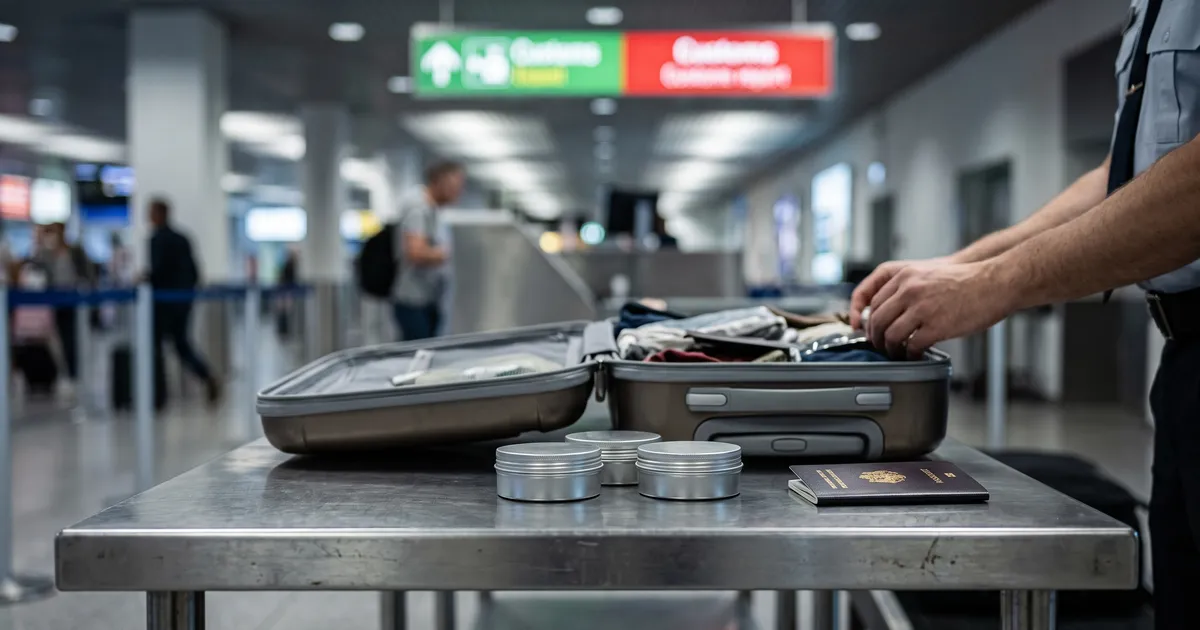
Travelling with nicotine pouches: what customs actually says, country by country
There is no European allowance for nicotine pouches. The law of the country you enter is what applies, and where they are banned the permitted quantity is zero.
Rolling Tobacco vs Packaged Cigarettes: The Price Gap Explained
Rolling your own cigarettes has long cost less than buying a pack. But where does that gap come from, and will it last? We break down the tax and the real cost per cigarette.
Nicotine replacement therapy (patch, gum, spray): how it works and how effective it is
Patches, gum, lozenges, sprays or inhalers: a factual overview of nicotine replacement therapy, how it works and its proven effectiveness for quitting smoking.