How to quit smoking: which methods actually work
Published on June 19, 2026 · Updated on September 10, 2026
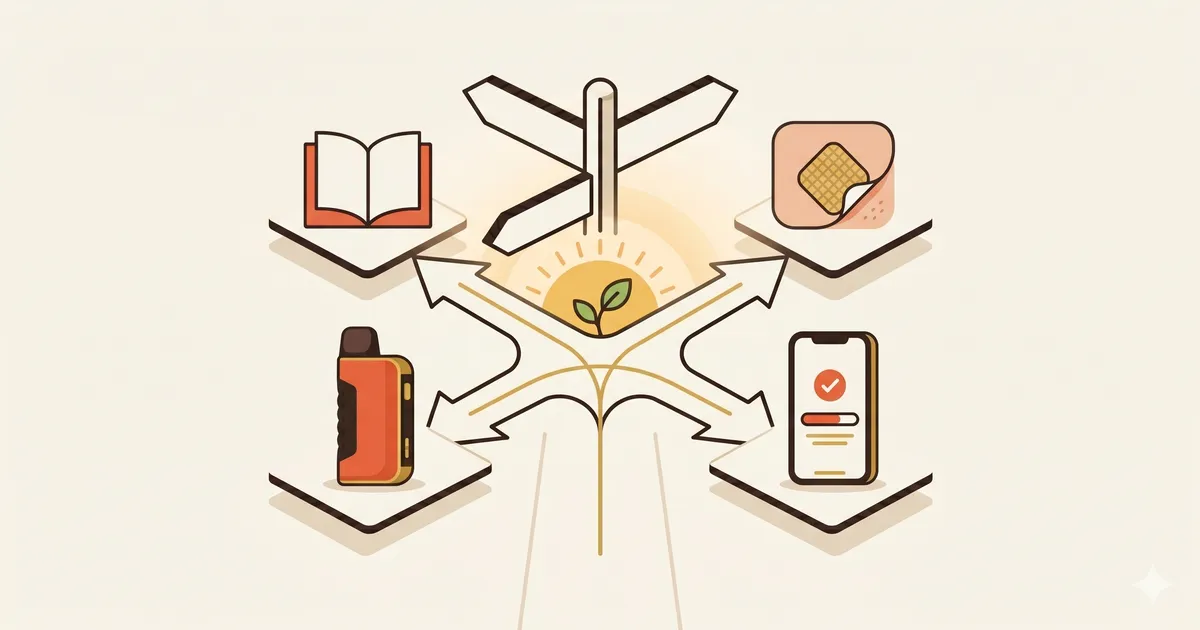
Quitting smoking depends less on willpower than on method. In July 2024 the World Health Organization published its first global clinical treatment guideline for tobacco cessation in adults: it endorses four medicines and stresses that behavioural support makes every one of them work better.
This guide sums up, method by method, what the literature establishes as of September 2026. Each section points to our detailed analysis of that method and to our quit smoking hub.
How to read effectiveness figures
Cochrane reviews express effectiveness as a risk ratio. A ratio of 1.55 means 55 % more quitters than in the comparison group, not a 55 % success rate. Two caveats: every figure has its own comparator, placebo for medicines, nicotine replacement for vaping, and each carries a certainty level ranging from low to high. Abstinence is always measured six months or more after the quit date.
Nicotine replacement: the over-the-counter benchmark
The reference Cochrane review pools 133 trials and 64,640 participants: nicotine replacement therapy raises the odds of quitting by 55 % compared with placebo (risk ratio 1.55, interval 1.49 to 1.61), on high-certainty evidence. A second review, on doses and forms, shows that combining a patch with a fast-acting form, gum or spray, beats a single form: risk ratio 1.27, across 16 trials and 12,169 participants, also high certainty. Details in our guide to nicotine replacement therapy.
Varenicline, cytisine, bupropion: the medicines
Varenicline is the best-established treatment: 2.3 times more quitters than placebo (41 trials, 17,395 participants, high certainty). Bupropion reaches 1.6 times placebo across 50 trials. Cytisine, plant-derived and far cheaper, reaches 1.3 times placebo on moderate-certainty evidence. All are prescription-only: see our page on quit-smoking medicines.
E-cigarettes: high certainty, but not a harmless product
This is where the evidence has shifted most. The Cochrane update of 26 August 2026 covers 80 randomised trials and 29,861 participants. Its conclusion, on high-certainty evidence: nicotine vaping helps more smokers quit than nicotine replacement, with a risk ratio of 1.61 (interval 1.23 to 2.12, across 11 trials and 4,114 participants), meaning 4 extra quitters per 100 people (interval 1 to 7). It also beats nicotine-free vaping (1.34, moderate certainty). Long-term data remain limited and vaping is not advised for non-smokers: see our e-cigarette explainer and, for hardware, our beginner's guide.
Support: the multiplier people skip
Adding behavioural support to a medicine raises quit rates by 15 % (risk ratio 1.15, interval 1.08 to 1.22, across 65 studies and 23,331 participants), on high-certainty evidence. The effect looks small, but it stacks on the treatment effect and costs almost nothing. Quitlines, pharmacy consultations and counselling all count. Our page on support and counselling covers the formats available.
Cold turkey, cutting down, willpower alone
The Cochrane review on reduction before quitting pools 51 trials and 22,509 participants. On the comparison that matters, cutting down first versus quitting abruptly, it finds no difference: risk ratio 1.01 (interval 0.87 to 1.17), across 22 trials and 9,219 participants, moderate certainty. The pace is not the issue. As for quitting with no help at all, it has no review of its own: it is the comparison group of the trials on medicines and nicotine replacement, and it is what their gains are measured against.
Methods with weak evidence
This needs saying plainly: hypnotherapy and acupuncture have no solid evidence of effectiveness, and the Allen Carr method rests on a very small number of trials. They are not dangerous, but they do not compare with validated treatments. Our review of hypnosis, acupuncture and the Allen Carr method goes through each study, and our analysis of the Allen Carr method, seminar and book sets out what to expect from them.
What these figures do not say
Three limits to state. Comparators differ, so one risk ratio cannot be read directly against another. Certainty levels vary too: high-certainty and low-certainty evidence do not commit you to the same degree. And trial participants are volunteers under follow-up, which makes observed quit rates more favourable than in the general population. These figures rank methods against each other, they promise nothing to an individual.
The ranking has held across several updates: a validated treatment plus support beats willpower alone.
Where to start
- Heavy dependence, first cigarette within 30 minutes of waking: go straight to varenicline or combination nicotine replacement.
- Repeated failures on patches and gum: nicotine vaping is the best-supported option against them.
- Tight budget: nicotine replacement is sold over the counter and reimbursed in several countries.
- In every case: add support, it improves any treatment.
- Set a date rather than debating the pace, abrupt and gradual perform alike.
Disclaimer: general information, which does not replace medical advice. These treatments have contraindications: talk to a doctor or a pharmacist before starting one. In France, the public quitline is reachable on 39 89.
Sources
- Tobacco cessation in adults, July 2024: World Health Organization
- Nicotine replacement therapy: Cochrane, CD000146
- Doses, forms and combination therapy: Cochrane, CD013308
- Varenicline and cytisine: Cochrane, CD006103
- Bupropion: Cochrane, CD000031
- Electronic cigarettes, update of 26 August 2026: Cochrane, CD010216
- Support added to pharmacotherapy: Cochrane, CD009670
- Reducing before the quit date: Cochrane, CD013183
- Help in France, 39 89: Tabac Info Service, Santé publique France
Related reading
Rolling Tobacco vs Packaged Cigarettes: The Price Gap Explained
Rolling your own cigarettes has long cost less than buying a pack. But where does that gap come from, and will it last? We break down the tax and the real cost per cigarette.
Nicotine replacement therapy (patch, gum, spray): how it works and how effective it is
Patches, gum, lozenges, sprays or inhalers: a factual overview of nicotine replacement therapy, how it works and its proven effectiveness for quitting smoking.
Getting Support to Quit Smoking: Counselling, CBT, Helplines and Apps
Brief advice from your doctor, specialist counselling, CBT, free helplines and apps: why support markedly raises your chances of quitting, especially combined with treatment.